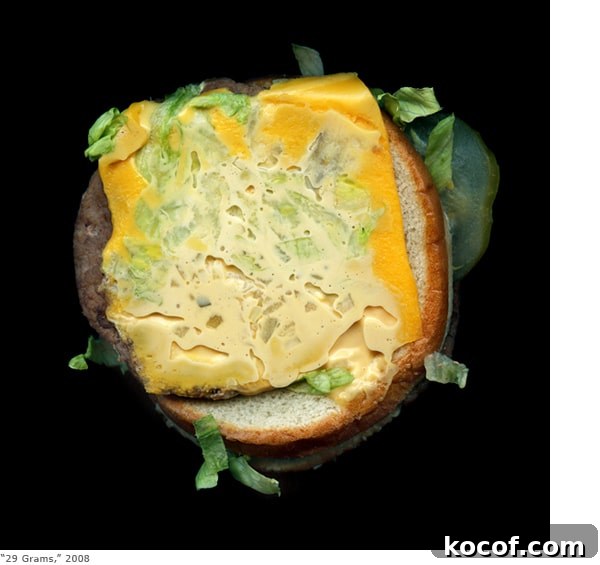
I recently discovered a striking and unsettling series of Fast Food photographs by Jon Feinstein. Each photograph is titled with the amount of fat contained in the depicted item, a concept that immediately reframes familiar foods as clinical specimens rather than branded products.
Since the 1950s fast food has become so global that its icons are often as recognizable as famous historical figures — their images deeply embedded in public consciousness. “Fast Food” is a typological study that presents hamburgers, French fries, chicken nuggets, and specialty sandwiches on a stark black background, removed from their usual context. Stripped of logos, packaging, and other identifying marks, the food appears almost to float in space under austere, uniform lighting. The result is both scientific and eerily beautiful: each item takes on a strangely seductive yet repellent quality. These photographs probe the complicated love/hate relationship many Americans have with fast food and illustrate how an element of popular culture can be simultaneously alluring and off-putting.
Feinstein donated one of his prints to help raise funds for Rachel Sussman’s project, The Oldest Living Things in the World. Wanting to support compelling creative work — and admitting a guilty curiosity about owning a piece of the series — I made a pledge. If the Kickstarter campaign reaches its goal, I’ll become the owner of the print titled “42 grams.”