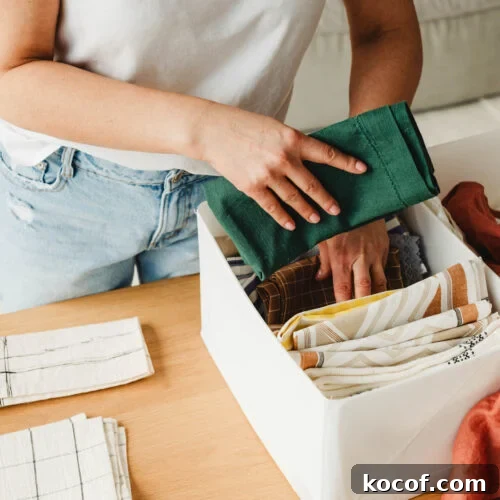
Looking for decluttering tips that actually work? Below are 53 practical, experience-tested strategies and mindset shifts I use at home and with clients to make letting go easier and prevent clutter from returning.

Most people I speak with aren’t lacking motivation to declutter. They’re unsure where to start, what to do when choices get hard, and how to maintain progress when life gets busy again.
Over the years I’ve decluttered our home through two international moves, growing kids, and several seasons of intense day-to-day demands. I’ve also spent years helping others simplify their belongings. What I’ve learned is that the advice that gets you started isn’t always the advice that helps you make the tougher decisions or keep things from creeping back in.
I’ve collected these tips over time, and they’re the ones I return to. I hope a few of them help you.
Decluttering tips to make letting go easier
Mindset tweaks
This is always my starting point: without the right decluttering mindset, nothing else sticks.
1. Consider the cost of keeping something. Every item needs space and upkeep, which costs time, energy, and money. Choose wisely.
2. Decluttering isn’t about losing things. It’s about clearing room for how you want to live now—not who you were or who you feel you should be.
3. Treat your home as a place to live, not a storage unit. Your space should support your life, not get in its way.
4. The more you own, the more your things own you. Notice the ongoing management cost. Let go of what doesn’t matter to free time and energy for what does.
5. The price you paid isn’t a reason to keep something. If it isn’t useful or meaningful now, it isn’t adding value to your life.
6. If it’s not being used, it’s already wasted. Unused items don’t serve anyone.
7. Consider what you gain by letting it go. Space, time, and mental clarity often outweigh the value of the object.
8. Let go of the idea that your home must reflect every past version of you.
9. Fuller homes don’t create fuller lives. Time, space, energy, and freedom do.
Simple decluttering rules that make decisions easier
10. Empty the space before deciding what goes back in. It’s easier to spot duplicates and excess when everything is visible.
11. Ask: would I buy this again today? If not, question why you’re keeping it.
12. Replace “What if I need this?” with “What does this cost me to keep?”
13. If you don’t use it, love it, or remember owning it, you likely don’t need it.
14. Everything must earn its place. The more space or maintenance an item requires, the more useful or meaningful it should be.
15. Most duplicates are unnecessary. Keep the best and release the rest.
16. Use the 20/20 rule for “just in case” items. If you can replace it in under 20 minutes for under $20, it’s usually safe to let go.
17. Try the 10-item rule. If everything feels like a keeper, aim to let go of 1–2 items out of every 10. Small reductions add up.
18. Consider borrowing what you rarely use. Occasional use doesn’t always justify ownership.
19. You can replace things if you need to. Give yourself permission to repurchase if it proves necessary.
20. Use the nice stuff, or let it go. Items are meant to be enjoyed, not hoarded indefinitely.
Practical home decluttering tips to build momentum
21. Declutter first, then organize. Buying containers for clutter only delays the problem.
22. Start with quick wins and obvious tosses. Discard expired food, old medicines, dried cosmetics, and broken items for immediate progress.
23. Look for friction points when you don’t know where to start. Tackle areas that slow you down or complicate daily routines for fast relief.
24. Work in small, defined areas. “Declutter the basement” is too broad. Start with a corner, a shelf, or a single box.
25. Give everything a limit. Decide a boundary—a drawer, shelf, or number of items—and when you reach it, something must go.
26. Your home didn’t get this way in a week. It won’t be fixed in one week either. Be patient.
27. Decluttering gets easier with practice. Each decision builds confidence and momentum.
Clothing decluttering tips
28. Use seasonal changes as a cue to declutter. Rotating clothes twice a year makes it easier to see what you actually wear.
29. Ask three questions: Does it fit your body, your lifestyle, and your personal style? If one answer is no, consider letting it go.
30. Use a time-based rule. If you haven’t worn it in 90 days (or six months), it’s likely not earning space in your wardrobe.
31. Consider consignment. It’s often easier than selling items individually and can make letting go feel worthwhile.
If your closet is next, a capsule wardrobe approach can be a useful follow-up.
Tips for decluttering paper clutter
32. Implement the touch-once rule. Decide immediately: act, file, recycle, or shred.
33. Don’t let junk mail enter the house. Recycle it before it piles up.
34. Ditch paper manuals, bills, and receipts when digital copies exist. Go paperless where practical.
Decluttering tips for sentimental and emotional items
35. Imagine you couldn’t keep everything. Which items would you choose first?
36. Ask if a photo could preserve the memory. Often the story matters more than the object.
37. Consider whether someone else could use it better. Passing items on gives them a second life.
38. Think about whose responsibility the item will become. Decluttering now lightens the load for you and loved ones later.
If sentimental decluttering feels hard, a focused guide on the topic can help you move through it thoughtfully.
Tips for decluttering shared spaces
39. Set the tone by starting with what you own. Leading by example is more effective than enforcing change.
40. Establish clutter-free zones. Clear expectations for shared areas reduce friction and make upkeep a shared responsibility.
41. Allow some spaces to be personal, not perfect.
If you’re navigating shared spaces or a partner who isn’t on the same page, there are strategies to handle that gently and effectively.
Tips to keep clutter from coming back
Getting rid of things is one step; preventing their return is the ongoing work. The tips below help maintain spaces after the initial declutter.
42. Define the purpose of every space. Rooms without a purpose quickly become clutter magnets.
43. Give everything a “home.” When items have a place, putting them away becomes automatic.
44. Leave breathing room in storage areas. Overfilled drawers and shelves stop being functional.
45. Notice when a space loses functionality. It likely needs a routine reset before clutter builds.
46. Establish a family donation station. A box or shelf makes letting go easy for everyone.
47. Keep a donation bag in your closet. Declutter as you dress to avoid future overwhelm.
48. Practice one-in, one-out. For each new item brought in, something else should leave.
49. Get rid of or use up one item a day. Consistent small actions are less overwhelming and highly effective.
50. Walk the house with a donation bag monthly. Small, regular edits add up over time.
51. Reuse incoming boxes as outgoing donation containers. They’re convenient and make donating easier.
52. Prevent clutter by being selective about new items. It’s easier to avoid clutter than to undo it.
53. Treat clutter as feedback, not failure. When it returns, use it as a sign to reset or adjust your systems.
How to start decluttering when you feel overwhelmed
If you’re surrounded by clutter and don’t know where to begin, remember: you don’t need to declutter your entire house this weekend.
Choose one small area, pull everything out, and set a 15-minute timer. Seeing everything at once makes decisions easier. You’ll be surprised how much you can accomplish in a focused 15 minutes. Repeat daily as you can.
Decluttering isn’t about shame over what you own. It’s about deciding which things still deserve space in your life.
If you’re encouraged and ready to begin, a simple room-by-room plan can guide your next steps and help you create a home that feels calmer and easier to manage.
Ready for a calmer, easier-to-manage home?
If you want support, declutter coaching can help you simplify belongings and create systems that make your home easier to maintain.